
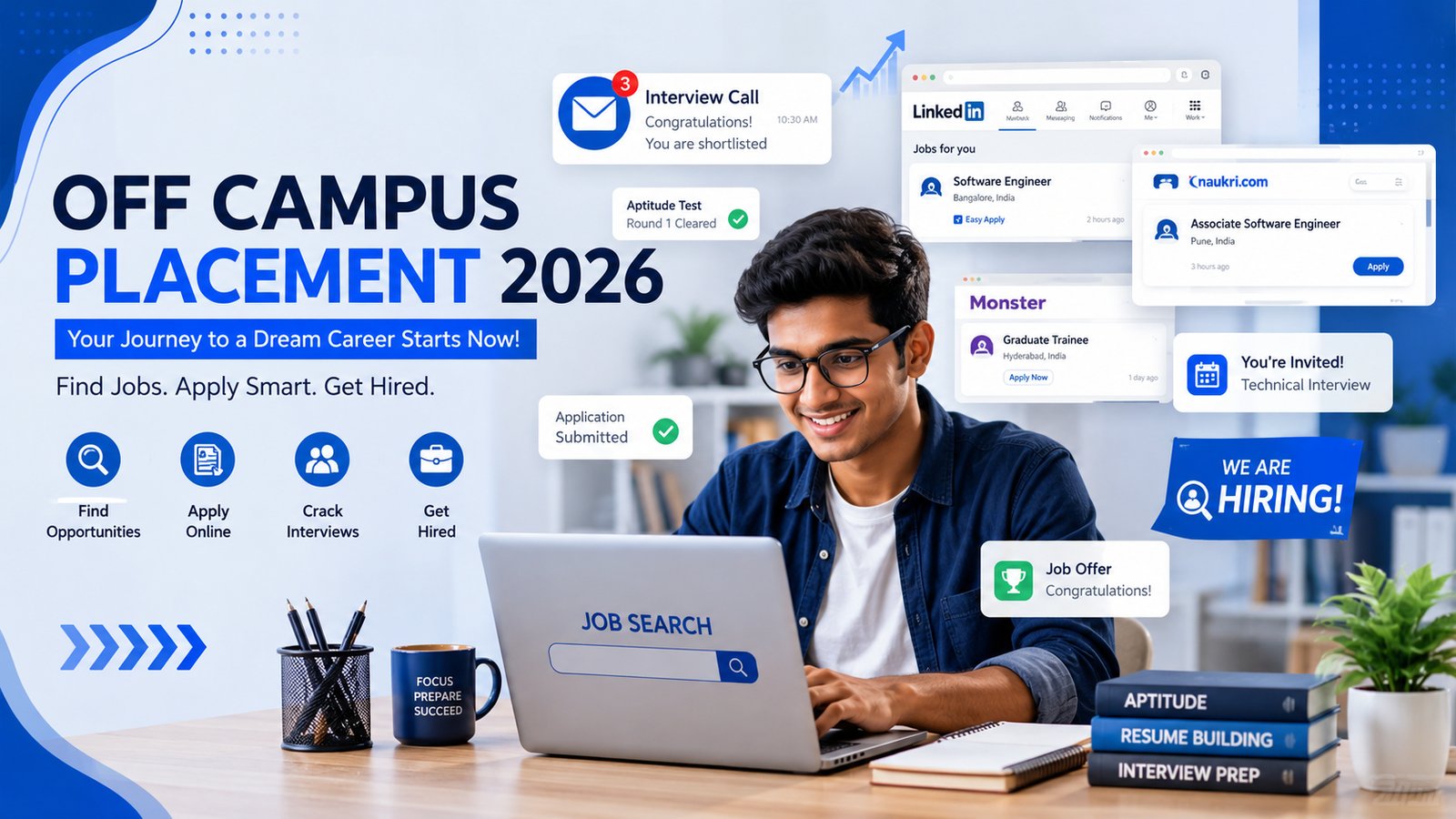
Off Campus Placement 2026: Complete Guide for 2024, 2025 & 2026 Batch Students
 Aditya Panchal|Jun 25, 2026|15 min read
Introduction
Your college placement season ended. Maybe only a handful of companies came to campus. Maybe you missed the shortlist by a few marks. Maybe the companies that did arrive had nothing relevant for your stream.
Whatever happened, you are now staring at one question: what next?
The answer is off campus placement — and in 2026, it is not the fallback route. It is, for millions of Indian freshers, the primary route to their first job.
40% of entry-level hiring in India now happens through off-campus channels. The companies are hiring. The drives are live. You just need to know where to look and how to show up.
This guide covers everything — what off campus placement actually means, how it differs from what happened at your college, where to find drives, and a step-by-step plan to get your first offer. For a broader view on the whole fresher search, our complete fresher job guide for India 2026 walks through the full search strategy.
What This Guide Covers
-
What is off campus placement — and how is it different from on-campus?
-
Who can apply for off campus drives in 2026?
-
Why off campus placement is growing in India
-
The 5 main types of off campus drives
-
Where to find off campus placement drives in 2026
-
How to prepare for off campus placement: step-by-step
-
Common mistakes freshers make during off campus job searches
-
Off campus placement vs on-campus placement: comparison table
-
FAQs about off campus placement 2026
-
Your action plan to start today
1. What is Off Campus Placement?
Off campus placement refers to any hiring process that happens outside the formal campus recruitment system. No placement officer coordinates it. No company comes to your college gates. You find the opportunity, you apply, and you get through on your own.
This includes:
- Company-hosted open drives (announced publicly on company websites or platforms)
- Pool campus drives (multiple colleges attend one centralised drive)
- Online application through job portals
- Walk-in interviews open to all graduates
- Referrals from seniors or alumni working at the company
- Direct recruiter outreach via LinkedIn or email
Off campus placement is not a niche path for people with elite colleges. It is the dominant hiring channel for freshers from tier-2 and tier-3 institutions — and increasingly for graduates from tier-1 colleges too, who want roles their placement cell did not offer.
2. Who Can Apply for Off Campus Drives in 2026?
Short answer: anyone who graduated in 2024, 2025, or 2026 and meets the eligibility criteria of a specific drive.
Most off campus drives for freshers specify:
If you graduated before 2024, eligibility narrows significantly. Most fresher drives specify recent batches. This is why acting in 2026 matters — the window for 2024 batch students is still open, but it will not stay open indefinitely.
3. Why Off Campus Placement is Growing — Fast
There are three structural reasons why off campus hiring now accounts for nearly half of all fresher hiring in India.
Companies Need Scale
TCS, Infosys, Wipro, Cognizant, Accenture, HCL — the biggest fresher employers in India cannot rely solely on campus visits. To hire 20,000+ freshers a year, they run national-level open drives that any eligible graduate from any college can attend. Campus recruitment is a supplement, not the whole strategy.
Tier-2 and Tier-3 Colleges Get Fewer Campus Visits
A college in a tier-2 city might get 10–15 companies for placement season. A college in metro cities might see 80–100. Off campus drives eliminate this disparity — the same TCS drive is open to a student in Bhopal and a student in Bengaluru.
Freshers Are More Proactive Than Ever
The generation graduating in 2026 is more digitally literate and more self-directed than any before it. The expectation of waiting for a placement cell to deliver a job is fading. Freshers who know how to find and apply to off campus drives consistently outperform those who do not — regardless of college brand.
4. The 5 Main Types of Off Campus Drives
Understanding what you are applying to helps you prepare correctly. Off campus drives are not all the same.
On Saarthi, you can filter drives by type — so if you specifically want online drives you can attend from home, or walk-in drives in your city, you see only what is relevant to you.
5. Where to Find Off Campus Placement Drives in 2026
This is where most freshers lose time. They hear about a drive three days after registration closed. Or they find it on a random Facebook group with fake details. Here is where to actually look:
The single most effective habit you can build: set up daily drive alerts on Saarthi. Every morning, you will see what is live today — no FOMO, no last-minute panic registrations.
6. How to Prepare for Off Campus Placement: Step-by-Step
Off campus placement rewards preparation. You do not have a placement cell scheduling your slots or briefing you on what Company X asks. You are on your own — so here is the full preparation sequence.
Step 1: Sort Your Documents Before You Need Them
You will waste hours during applications if you hunt for these every time. Prepare once and keep ready:
- Updated resume — ATS-formatted, 1 page, no graphics or tables (10 foolproof resume tips for freshers →)
- Consolidated marksheets — semester-wise PDFs or scans
- Consolidated passing certificate or provisional degree
- Aadhaar, PAN, passport or Voter ID
- 1 recent passport-size photo — white background, formal attire
- LinkedIn profile URL — complete, keyword-rich, with a professional photo (LinkedIn profile guide for freshers →)
On Saarthi, the AI resume builder helps you create an ATS-ready resume in minutes — formatted correctly, keyword-optimised for each role, and download-ready.
Step 2: Build Your Aptitude Foundation
Almost every off campus drive — IT or non-IT — starts with an aptitude test. The sections are predictable. Prepare for them systematically:
- Quantitative Aptitude: percentages, profit & loss, time-distance-work, ratios, averages
- Logical Reasoning: series completion, syllogisms, direction sense, data arrangement
- Verbal Ability: reading comprehension, sentence correction, vocabulary, para-jumbles
- Technical (for IT roles): DSA basics, OOP concepts, SQL queries, DBMS, OS fundamentals
Dedicate 45–60 minutes a day for 3–4 weeks. The goal is not mastery — it is speed and accuracy at the test level these drives actually use.
Step 3: Build and Polish Your Digital Presence
Before you apply to a single drive, complete these profiles:
- LinkedIn: headline, about section, education, skills, at least 2–3 projects or internship descriptions
- GitHub (for tech roles): at least 2 pinned repositories with clean READMEs
- Portfolio or personal website (for design, content, marketing roles): 3–5 pieces of work minimum
Companies check LinkedIn before shortlisting. A blank profile or a half-filled one hurts your chances even after you clear an aptitude round.
Step 4: Apply With Volume — But Apply With Intent
Off campus placement is partly a numbers game, but mindless applications do not work. The right balance:
- Apply to 8–12 drives per week — enough to create momentum without burning out
- Tailor your resume objective for each role category (IT vs non-IT vs operations)
- Track every application in a spreadsheet: company, role, date applied, test status, interview stage
- Follow up on applications that go silent after 7–10 days — a short email to the recruiter is acceptable
Step 5: Prepare for the Interview Rounds
Most off campus drives have 3–4 rounds after the aptitude test:
-
Group Discussion (GD): topics are usually current affairs, business scenarios, or ethical dilemmas. Practise in groups of 4–6 with a timer.
-
Technical Round: specific to the role. For IT — DSA problems, coding in C++/Java/Python, SQL queries. For non-IT — domain knowledge, case questions.
-
HR Round: your story, your motivation, salary expectations, notice period, location flexibility. Prepare concise, honest answers for all standard questions.
-
Managerial Round (for senior fresher roles): decision-making scenarios, leadership examples from college, conflict resolution.
Practise all rounds out loud. Not in your head. Out loud, with a timer, with feedback from a peer or mentor. For a structured week-by-week plan, our complete interview preparation guide for freshers 2026 covers every round. And knowing what fresher salary to target in 2026 means you won't fumble the HR round's compensation question.
7. Common Mistakes Freshers Make in Off Campus Job Searches
These are the mistakes that cost people offers — not lack of skill.
- Applying too late: off campus drives open and close within days. By the time you see a LinkedIn post about a drive, registration may already be closed. Set daily alerts.
- Sending the same resume everywhere: an IT services resume sent to a fintech startup signals you did not read the JD. One resume does not fit all.
- Ignoring aptitude preparation: the most common point of elimination in mass hiring drives is the aptitude round — not the interview. Prepare for it as seriously as the technical round.
- No follow-up after rounds: most freshers assume silence means rejection. A polite follow-up email after 7 days is professional, not pushy.
- Applying only to famous brands: TCS, Infosys, Wipro get 10,000+ applications for every open drive. A growing startup with 50–200 employees hiring freshers is often a faster and higher-quality opportunity.
- Not verifying drive details: fake drives circulate on WhatsApp and social media. Before registering for any drive, verify it on the company's official career page or a trusted platform like Saarthi.
8. Off Campus Placement vs On-Campus Placement
Understanding the difference helps you plan your time and energy correctly.
The honest truth: if your campus placement did not result in an offer — or did not produce the kind of offer you wanted — off campus is not a second-best option. It is your primary path. Own it.
9. FAQs About Off Campus Placement 2026
Can 2024 batch students still apply for off campus drives in 2026?
Yes. Most major fresher drives accept the 2024 batch alongside 2025 and 2026. Some drives extend to 2023 batch as well, though this becomes rarer. The key filter is the eligibility criteria listed in each drive notification — always read it carefully before applying.
Is off campus placement harder than on-campus placement?
It is more competitive in terms of volume — you are one applicant among thousands rather than one among your batchmates. But it is also more accessible — the opportunity pool is dramatically larger. Students who prepare systematically for off campus drives consistently report better outcomes than students who waited passively for campus recruitment.
Do companies care which college you are from for off campus drives?
Less than you think, for most roles. For elite programmes at McKinsey, Goldman Sachs, or Google, college pedigree still matters. For the vast majority of fresher hiring — IT services, BPO, banking, FMCG, e-commerce operations — what companies evaluate is your aptitude score, communication, technical knowledge, and attitude. Off campus is the great equaliser.
How many off campus drives should I apply to?
Target 8–12 per week during an active job search. At this rate, you create enough pipeline to have parallel processes in progress, which reduces anxiety and keeps your skills sharp. Track everything — it takes 5 minutes to maintain a spreadsheet and saves hours of confusion.
What is the difference between an off campus drive and a walk-in interview?
An off campus drive typically has multiple rounds — online aptitude test, GD, technical interview, HR round — spread over days or weeks. A walk-in interview happens in one day: you show up at the venue, submit your resume, and are assessed the same day. Walk-in drives are common in BPO, retail, banking, and operations roles. Regular off campus drives are more common in IT, BFSI, and structured corporate environments.
Where is the most reliable place to find verified off campus drives?
The most consistently updated and verified source is Saarthi's off campus drives page. Every listing is manually verified — no fake drives, no expired registrations, no ghost companies. The platform is built specifically for the 2024, 2025, and 2026 batch.
10. Your Action Plan to Start Today
Reading about off campus placement is not the same as doing it. Here is exactly what to do after you close this page:
-
Build your resume — 1 page, ATS-formatted. Use Saarthi's free ATS resume builder to get it right in one go.
-
Complete your LinkedIn profile — headline, about section, skills, at least one project. Set Open to Work.
-
Browse today's active drives — go to Saarthi off-campus drives and filter by your stream and city.
-
Bookmark 3–5 drives you are eligible for and register today — not next week.
-
Start aptitude preparation — 45 minutes today, every day for the next 3 weeks.
-
Create your application tracker — company name, role, date applied, current stage.
-
Check back on Saarthi drives every morning — drives go live and close within 48–72 hours. Daily checking is not optional; it is the strategy.
The Bottom Line
Off campus placement in 2026 is not a backup plan. It is how the majority of freshers in India — regardless of college, city, or stream — land their first job.
The students who succeed at it are not the most talented. They are the most prepared and the most consistent. They check for drives daily. They apply with a tailored resume. They prepare for aptitude rounds they know are coming. They follow up. They do not stop after one rejection.
The infrastructure to do all of this exists. The drives are running right now. The question is whether you are showing up.
Track today's off campus drives on Saarthi — updated daily. Browse Off Campus Drives on Saarthi →. Read more career guidance on the Saarthi blog.