
How to Check if a Work From Home Job Is Genuine (2026): A 10-Minute Verification Checklist for Indian Freshers
 Aditya Panchal|Oct 14, 2026|11 min read
Introduction
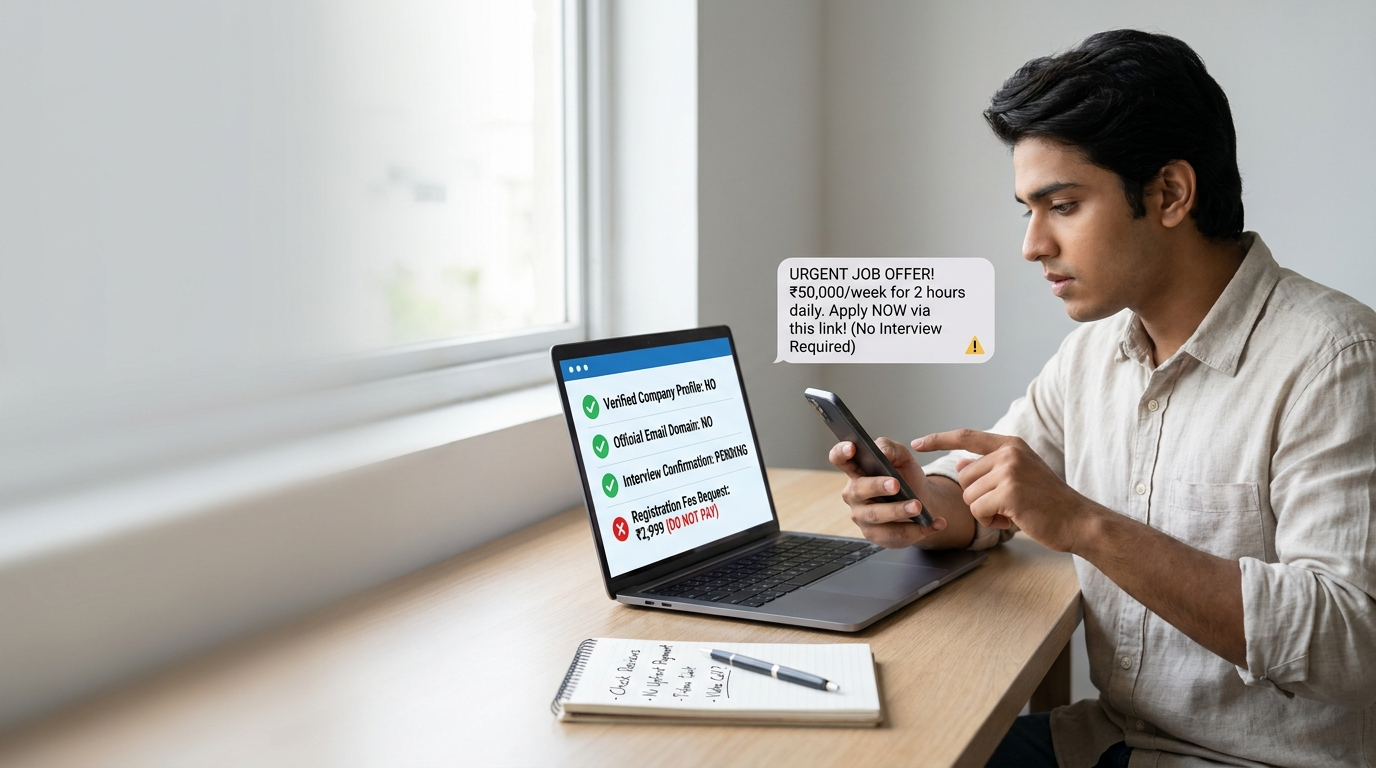
You get a WhatsApp message at 9 PM. It says you have been shortlisted for a work from home job, the pay is ₹30,000 a month, and you only need to work two hours a day. No interview, no experience needed, just reply YES.
If you are a fresher looking for your first remote job, this message feels like luck. In most cases it is a trap.
Work from home job scams in India have become one of the most common ways young job seekers lose money and personal data. The good news is that you can check almost any offer in about ten minutes, without any special tools. This guide gives you the full process: how to tell if a work from home job is real, the red flags of fake job offers, the scam types doing the rounds in India right now, what a genuine hiring process looks like, and what to do if you have already been targeted.
Quick Answer: Is This Work From Home Job Real?
A work from home job is likely genuine if the company has a verifiable identity, the recruiter contacts you from an official email domain, you go through a real interview, and you are never asked to pay money at any stage. If any one of those four things is missing, treat the offer as fake until proven otherwise.
Here is the 10-minute version:
- Search the company name plus the word 'scam' or 'reviews'.
- Check the company on LinkedIn and its official website.
- Look at the email address and the website domain.
- Confirm the job exists on the company's own careers page.
- Check whether you are being asked for money.
- Look for a real interview process.
- Read the job description for specifics.
- Test the pay against the work.
- Never move the conversation to WhatsApp or Telegram groups.
- Ask a friend or senior before you reply.
The rest of this article explains each step in detail.
Why Are Work From Home Job Scams So Common in India?
Work from home job scams are common in India because millions of freshers, students, homemakers and people in smaller cities want flexible work, and scammers know that the word 'remote' gets attention. Scams are cheap to run, hard to trace, and easy to scale through WhatsApp, Telegram and Instagram.
Three things make the problem worse:
- Remote work is genuinely attractive. Since the pandemic, many people want to work from home, and scammers copy the language of real remote jobs.
- Freshers have little experience to compare against. If you have never been through a hiring process, you do not know what is normal and what is not.
- Genuine remote jobs for freshers are limited. Many ads that say 'work from home' are actually hybrid roles, and truly remote entry-level roles are competitive. That gap is exactly where scammers operate, because they promise easy money that real employers do not.
A useful rule to remember: real jobs are specific and slightly boring, and fake jobs are vague and exciting.
How Do You Check if a Work From Home Job Is Genuine? (The 10-Step Checklist)
You check a work from home job by verifying the company, the recruiter, the job posting, and the hiring process separately, because scammers can fake one of these but rarely all four. Go through the steps below before you share documents, pay anything, or join any group.
Step 1: Search the company name with 'scam' or 'reviews'
Open Google and search the exact company name followed by 'scam', 'fraud' or 'reviews'. Then search the same name on Reddit. Indian job seekers regularly discuss suspicious offers in communities like r/india and r/WorkOnline, and a thread about the same company is a strong warning sign. No results at all is also worth noting. A company with no online footprint offering ₹40,000 a month to freshers is suspicious.
Step 2: Check the company on LinkedIn and its official website
A real company usually has a LinkedIn page with employees who list it as their workplace, a history of posts, and a working website with an About page and contact details. Be careful with pages that have very few followers, no employees, or a profile created recently. Also check whether the recruiter who contacted you actually appears as an employee on the company's page.
Step 3: Look closely at the email address and website domain
A genuine recruiter writes from an email address that ends with the company's own domain, such as name@company.com. Be cautious if the email comes from a free address like Gmail or Yahoo, or from a lookalike domain with small spelling changes such as an extra letter or a hyphen. Fake offer letters often use real company logos, so a good-looking PDF proves nothing. The sender's domain matters far more than the design.
Step 4: Confirm the job exists on the company's careers page
Go to the company's official website yourself (do not click the link in the message) and look for the same role on its careers page. Larger companies almost always list openings there or on their official LinkedIn page. If the role is nowhere to be found, ask the recruiter for the link to the official posting. A real recruiter will have no problem sharing it.
Step 5: Check whether you are being asked for money
This is the clearest test of all. No genuine employer asks you to pay for registration, training, a starter kit, software, a laptop, 'verification', or a security deposit. Employers pay you, not the other way round. If any payment is requested, even ₹99 or ₹500, stop the conversation. Small amounts are used on purpose because they feel harmless, and they are often the first step toward larger losses.
Step 6: Look for a real interview process
Legitimate companies screen candidates. That usually means an application, a screening call, one or more interviews, and sometimes a short test or assignment. If you receive an offer letter within hours of applying, with no conversation at all, it is almost certainly fake.
Step 7: Read the job description for specifics
A real job description names the role, the team, the tools, the responsibilities and the skills needed. A fake one says things like 'simple online work', 'copy-paste jobs', 'like and subscribe tasks' or 'earn daily from your mobile'. If you finish reading and still cannot say what you would do all day, that is a bad sign.
Step 8: Test the pay against the work
Ask yourself whether the salary makes sense for the skill involved. A fresher customer support role might pay a modest monthly salary. A role offering several times that amount for a couple of easy hours a day does not match how the market works. If the pay seems too good, the offer is designed to switch off your caution.
Step 9: Be careful when the conversation moves to WhatsApp or Telegram
Many genuine recruiters do use WhatsApp for quick coordination, so this alone is not proof of a scam. The warning sign is when the entire process, including the 'interview' and the 'tasks', happens inside a chat app or a Telegram group with strangers, and nothing is ever official. Be extremely careful if you are added to a group with people posting screenshots of earnings.
Step 10: Talk to someone before you reply
Scammers use urgency: 'Reply in 30 minutes or the slot goes', 'Only 3 seats left'. Real employers rarely rush a fresher this way. Show the message to a friend, a senior or a family member. A second pair of eyes catches things you miss when you are excited.
What Are the Red Flags of a Fake Job Offer in India?
The biggest red flags of fake job offers in India are upfront payment requests, no interview, vague job descriptions, unrealistic salaries, free email addresses, and pressure to act fast. Any one of them is a reason to pause. Two or more together almost always mean a scam.
Here is a quick reference you can save:
- Asks for registration, training or kit fees — money scam
- Offer letter without any interview — fake offer or data theft
- Recruiter uses Gmail or a lookalike domain — impersonating a real company
- 'Data entry', 'typing' or 'copy-paste' work at high pay — advance-fee scam
- Daily payouts for simple tasks — task scam that escalates
- Added to Telegram groups with earning screenshots — social proof manipulation
- Asks for Aadhaar, PAN or bank details too early — identity theft
- Pressure to reply or pay immediately — urgency tactic
- Job not listed on the company's careers page — fake posting
- Salary far above market for a fresher — bait
Keep in mind that some legitimate companies do offer data entry roles. They simply do not advertise them as easy money to freshers on social media, so treat that wording in a work from home ad as a signal to investigate, not to apply.
What Are the Most Common Work From Home Scams in India Right Now?
The most common work from home scams in India are task-based scams, advance-fee or registration scams, fake offer letters, data entry scams, and fake recruiter impersonation. Knowing the script helps you recognise it when it arrives.
Fake work from home job on WhatsApp: the task scam
You get a message offering part-time work, such as rating products, liking videos or boosting a listing. You are paid a small amount at first, perhaps a few hundred rupees, which builds trust. Then you are told to 'invest' a deposit to unlock higher-paying tasks, and the amounts keep growing. Once you stop paying, the money is gone and the group goes silent. If a job asks you to deposit money to earn, it is not a job.
Registration and training fee scams
The 'company' tells you that you are selected but must pay for registration, ID card, training material or software. The fee is presented as refundable. It is not. No legitimate employer collects fees from candidates.
Fake offer letters and recruiter impersonation
Scammers copy the logo, name and format of a real company, then send you a convincing offer letter. They may ask for money for 'documentation' or collect your personal details for misuse. Always verify with the company directly using contact details from its official website.
Data entry and typing job scams
You pay to access a portal, receive large volumes of work with impossible deadlines, and are then told your work was rejected so you owe a penalty. The structure is designed so that you can never 'pass'.
Cheque and equipment scams
The scammer sends payment for 'office equipment' and asks you to transfer part of it to a vendor. The original payment later fails or is reversed, and you lose your own money. Never send money from your account to anyone as part of a job.
What Does a Genuine Remote Hiring Process Look Like?
A genuine remote hiring process usually includes a clear job posting, an application, a screening call, at least one interview, an offer letter from an official email, and a contract or joining formalities handled by a verifiable HR contact. It may be slower than scam offers, and that is a good thing.
Expect these stages:
- Application. You apply through the company's careers page, a job platform, or LinkedIn.
- Screening. A recruiter calls or emails you to check your background and availability.
- Interview or task. For content, design, SEO or support roles, you may be given a short test. Real tests are limited in scope and unpaid tests should be small, not full client work.
- Offer. You receive an offer letter from an official domain with a named HR contact, role, salary and joining date.
- Onboarding. Your employer may ask for documents like ID and bank details, but only after the offer and through official channels.
The key difference is that a genuine process has friction. You are evaluated, questions are asked, and nobody rushes you into paying or joining a group.
Where Can Freshers Find Genuine Work From Home Jobs in India?
Freshers can find genuine work from home jobs on established job platforms, company career pages, LinkedIn, and curated boards that list work arrangement clearly, such as Saarthi. The aim is to apply where employers post directly, not where recruiters message you out of nowhere.
The roles most likely to hire freshers remotely include customer support, content writing, social media and digital marketing assistance, SEO support, data analysis and virtual assistance. Many of them still involve targets, shifts or a probation period, so read the details before you accept.
When you search for genuine work from home jobs for freshers, use these habits:
- Filter by 'Work from home' or 'Remote' and by 0 to 1 years of experience.
- Apply directly through the platform or the company's own page.
- Keep a record of every application, so you can verify any follow-up message against it.
- Ignore messages from recruiters about roles you never applied for, especially if they arrive on WhatsApp first.
How Can Saarthi Help You Find Real Remote Jobs?
Saarthi is a fresher job and internship platform in India that lists work from home roles with the work arrangement clearly tagged, so you spend less time guessing whether a job is truly remote. Listings are refreshed daily from employers' ATS feeds, which means they originate from companies' own hiring systems rather than from random messages or unverified forwards.
Here is how that helps with the problems covered in this guide:
- Clear work mode. Saarthi tags each role as remote, hybrid or on-site based on the source posting, so a 'work from home' title does not hide a three-day office requirement.
- Fresher-focused filters. You can filter by role, work mode and salary, which helps you spot unrealistic pay quickly.
- Free to browse. You never need to pay to see or apply to listings. If any site or person claiming to represent a job platform asks you for money, treat it as a scam.
- A single place to compare. Instead of chasing links in Telegram groups, you can browse remote roles in one place and apply through the proper route.
You can explore current openings on the Saarthi work from home jobs page and read more guides in the Saarthi remote jobs blog. One honest note: no platform can guarantee that every employer is perfect. Even when you apply through Saarthi or any other job board, run the same quick checks from this guide on the company before you share sensitive documents.
What Should You Do if You Have Already Been Scammed?
If you have been scammed in a work from home job, stop all payments immediately, contact your bank, report the incident on cybercrime.gov.in or call the 1930 cybercrime helpline, and keep all evidence. Acting within the first hours gives you the best chance of limiting the damage.
Follow these steps in order:
- Stop sending money. Do not pay any 'release fee', 'tax' or 'refund charge'. Scammers often ask for more after the first payment.
- Call your bank right away. Ask them to block the transaction or freeze your card, UPI ID or account if needed.
- Report on the national portal. File a complaint at cybercrime.gov.in or call 1930 as soon as possible.
- Save evidence. Keep screenshots of chats, the phone numbers, payment receipts, UPI IDs, websites and emails.
- Report the account or group. Use the reporting tools on WhatsApp, Telegram, Instagram or LinkedIn to flag the profile.
- Protect your identity. If you shared Aadhaar, PAN or bank details, monitor your accounts and be cautious about calls or messages that follow.
- Tell someone. Scams rely on shame and silence. Telling a friend or family member helps you act faster and helps them avoid the same trap.
And do not fall for 'recovery agents' who contact you afterwards and promise to get your money back for a fee. That is usually a second scam.
Final Thoughts
A genuine work from home job does not need you to hurry, pay, or keep quiet. It needs you to apply, get evaluated and be hired through a process you can verify. If you remember only one thing from this guide, make it this: if a job asks you to pay before you earn, walk away.
Use the 10-step checklist every time an offer arrives, apply where employers post openly, and give yourself the time to verify. When you are ready to start looking, browse verified-source remote roles for freshers on Saarthi and apply with confidence.