Remote Job vs Office Job for Freshers: Which Is Better to Start Your Career in 2026?
 Aditya Panchal|Oct 16, 2026|12 min read
Introduction
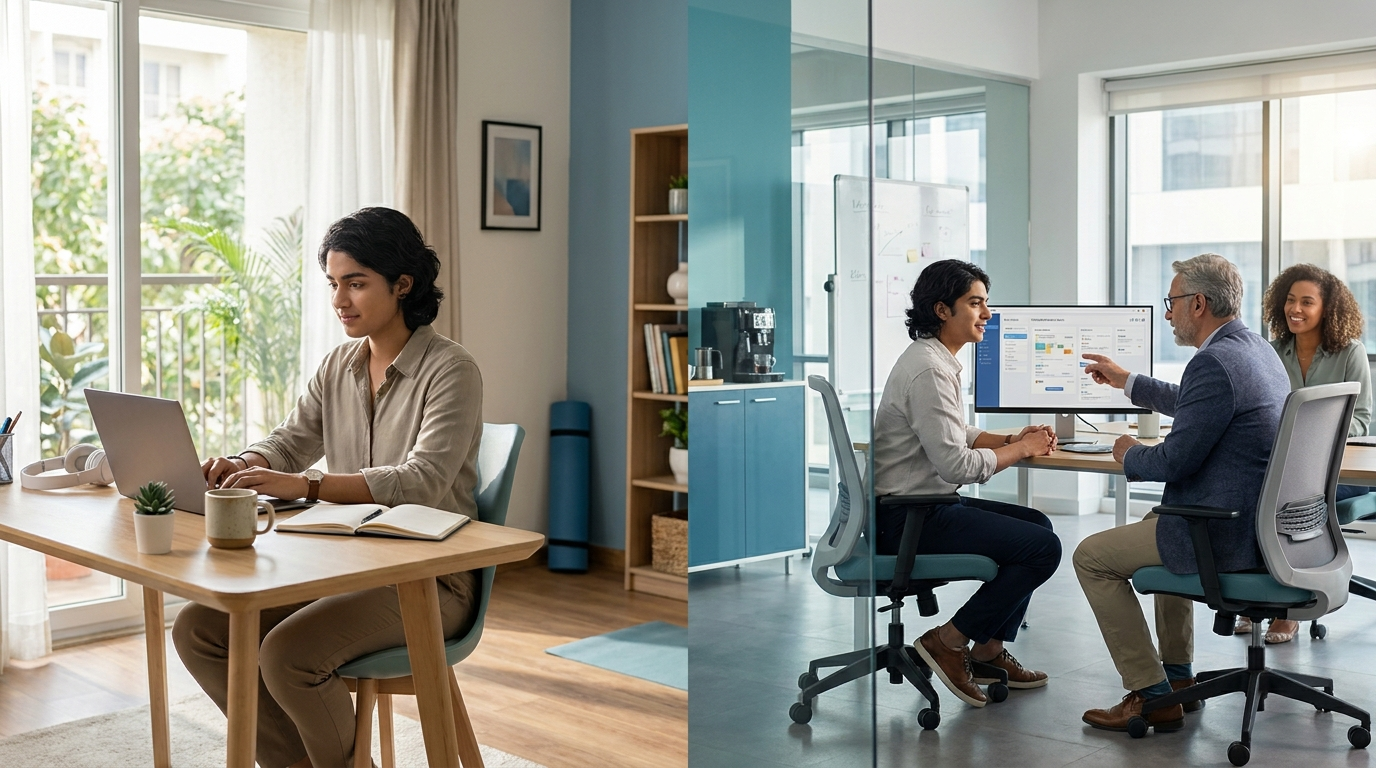
Imagine you have two offers in your inbox. One is a work from home job where you wake up, open your laptop and start. The other is an office job with a daily commute, a desk and a team sitting around you.
Most freshers pick the remote offer without thinking twice. Working in pyjamas, saving travel money and skipping the traffic sounds like an easy win. But a first job does more than pay your bills. It decides how fast you learn, who teaches you, and what your second job looks like.
So is it smart to start with a remote job as a fresher, or should you begin in an office? This guide gives you an honest answer. We compare remote job vs office job for freshers on learning, feedback, growth, pay, cost and risk, explain who should choose which, and give you a simple way to decide for yourself.
Quick Answer: Should Freshers Start With a Remote Job or an Office Job?
For most freshers, starting in an office or a hybrid setup is better for learning faster, while a fully remote first job works best if you already have self-discipline, a skill you can show, and a manager who gives regular feedback. Remote is not bad for freshers. It is just less forgiving, because nobody is sitting next to you to correct small mistakes.
Your best choice depends on three things:
- Your skill level. Can you already do part of the job without close supervision?
- The type of role. Some roles can be learned alone, while others need mentoring.
- The support you will get. Does the company have a structured onboarding and a manager who checks in?
If you answer yes to all three, a remote first job can work very well. If you answer no to even one, an office or hybrid job is usually the safer start.
What Is the Difference Between a Remote Job and an Office Job for Freshers?
The main difference is how you learn and get feedback: in an office you absorb things by watching people and asking quick questions, while in a remote job you learn through written communication, scheduled calls and your own initiative. Everything else, from cost to networking, follows from that.
Here is a side-by-side comparison:
| Factor | Remote job | Office job |
|---|---|---|
| Learning speed | Slower unless onboarding is strong | Faster through observation and quick questions |
| Feedback | Scheduled or written, can be delayed | Frequent and informal |
| Networking | Needs deliberate effort | Happens naturally |
| Cost | No commute, no relocation | Commute, rent or relocation costs |
| Flexibility | High | Low to medium |
| Discipline needed | Very high | Moderate, as the environment helps |
| Job options | Not limited to your city | Limited to where you can reach |
| Visibility for promotion | Depends on how well you communicate your work | Easier, as managers see you daily |
| Salary | Varies widely, not automatically higher | Varies widely, often similar for the same role |
Notice that neither column wins everything. The right answer depends on what you need most in the first year.
Is Remote Work Good for Freshers? The Real Benefits
Yes, remote work can be good for freshers because it removes location barriers, saves money and time, and builds self-management skills early. These benefits are real, especially if you live in a smaller city or cannot relocate.
The biggest advantages are:
- No relocation cost. You do not need to move to Bengaluru, Pune or Gurugram and pay high rent in your first year.
- Access to more employers. You can apply to companies outside your city, including startups that hire remotely.
- Time and money saved on commute. Those hours can go into learning a new skill or building a portfolio.
- Flexibility. You can manage family responsibilities, studies or a side learning plan more easily.
- Early self-management. If you succeed in a remote job, you learn to plan your work, communicate clearly and deliver without supervision. These are skills that employers value.
- A level playing field in some roles. In roles like content writing, SEO, design or development, your work speaks for itself, not your location.
These benefits matter, but they only help if you can actually land a good remote role and grow in it.
What Are the Disadvantages of Starting With a Remote Job?
The main disadvantages of a remote first job are slower learning, less feedback, isolation, a smaller professional network and a higher risk of drifting without direction. Experienced professionals handle these well because they already know how work is done. Freshers often do not.
Here is what freshers commonly struggle with:
- Slower learning. In an office you overhear how a senior handles a client call or fixes a problem. Remotely, you only see what is shared with you.
- Hesitation to ask questions. Typing a message to a busy manager feels harder than turning to a colleague, so many freshers stay stuck longer than they should.
- Less feedback. Without regular reviews, you may repeat the same mistake for weeks.
- Isolation. Working alone every day can affect motivation, especially in the first six months.
- Weaker network. Mentors, referrals and friendships form more slowly when you only meet people on video calls.
- Blurred boundaries. Work and home mix, which can lead to overworking or procrastinating.
- More competition and more scams. Genuine remote roles for freshers attract many applicants, and fake offers target people searching for them. Read our guide on how to check if a work from home job is genuine before you apply.
Some experienced engineers and managers argue that people with no work experience grow faster by starting on-site, and this view comes up often in online career discussions. It is an opinion, not a rule, but the reasoning behind it is worth taking seriously.
What Are the Benefits of Starting Your Career in an Office?
Starting in an office gives freshers faster learning, easier mentoring, built-in structure and a natural professional network. For a first job, those advantages often outweigh the convenience of working from home.
The practical benefits are:
- Learning by observation. You see how experienced people communicate, prioritise and solve problems.
- Quick doubts, quick answers. A two-minute question to a colleague saves you an hour of guessing.
- Easier mentorship. Seniors are more likely to guide someone they see every day.
- Structure. Fixed hours and a shared environment help you build routine without relying only on willpower.
- Networking and references. The people you meet in your first job often become your references and referrals later.
- Visibility. Your manager sees your effort directly, which helps with growth and promotions.
The trade-off is real too: commute time, higher living costs if you relocate, and less flexibility. If those are major problems for you, that matters as much as the learning benefits.
Which Freshers Should Choose a Remote Job?
Freshers should choose a remote job if they have a demonstrable skill, strong self-discipline, a role that can be learned independently, and a company that offers structured onboarding and regular feedback. If you tick most of these boxes, remote is a sensible first step.
A remote first job usually suits you if:
- You already have proof of skill. This could be a portfolio, internship work, freelance projects, a blog, a GitHub profile or sample work.
- Your role is output-based. Content writing, SEO, graphic design, video editing, development, data analysis and customer support often have clear deliverables.
- You live where local options are limited. If good jobs are far away or relocation is not possible, remote can open doors that would otherwise stay closed.
- You have a quiet workspace and reliable internet. This is basic, but it decides whether you can work well.
- You are comfortable writing and asking for help. Remote teams run on clear written communication.
- The company is organised. Ask about onboarding, who your manager will be, and how often you will have one-on-ones.
Which Freshers Should Start in an Office Instead?
Freshers should start in an office or hybrid job if they have no prior work experience, need guidance to learn the role, get distracted easily, or are entering fields where on-the-job mentoring matters a lot. In these cases, the first year is about learning, and an office speeds that up.
Office or hybrid is usually the better start if:
- You have never worked before, not even an internship. You will benefit from seeing how a workplace operates.
- Your role needs mentoring. Sales, operations, finance, consulting, HR, project management and many technical roles depend on learning from experienced people.
- You struggle with focus when you are alone. There is no shame in this. Many people work better with structure around them.
- You want a strong network early. An office helps you build contacts across teams.
- The remote company has no onboarding plan. A remote job with no training and no feedback is not a safe place to learn.
Is a Hybrid Job the Best of Both Worlds?
A hybrid job often gives freshers the best balance, because you get in-person learning on office days and flexibility on remote days. For many first-time employees, two or three days in the office is the sweet spot.
There is one warning. Many job ads labelled 'work from home' are actually hybrid, and some 'remote' roles expect you to be in the office on certain days or to live in a specific city. Always read the work mode carefully so you know what you are agreeing to. A role that says 'remote' in the title but requires office visits in the fine print is not truly remote.
How Do You Decide Between a Remote and an Office Job? A 5-Question Test
You can decide by asking yourself five honest questions about your skills, habits, role, support and situation, then choosing the option that fits most answers. Write down your answers instead of just thinking about them.
- Can I do the core tasks of this role without someone guiding me? If yes, remote becomes realistic. If not, choose office or hybrid.
- Do I work well alone for long hours? Be honest. If your focus drops without people around, office is safer.
- Will this company train and support me? Ask how onboarding works. Good remote teams have a clear answer.
- What are my life constraints? Family, finances, health or location can legitimately make remote the better choice.
- What do I want after two years? If you want to move into a leadership or client-facing track, early in-person experience can help. If you want to freelance or work with global teams, early remote experience can help.
If most of your answers point to remote, take the remote role and prepare well. If they are mixed, hybrid is a practical middle path.
How to Succeed in Your First Remote Job
To succeed in your first remote job as a fresher, communicate often, ask for feedback early, document what you learn, and keep a fixed daily routine. You cannot rely on being noticed, so you have to make your progress visible.
Use these habits from day one:
- Over-communicate. Send a short end-of-day update on what you finished, what is pending and what is blocking you.
- Ask questions early. Do not stay stuck for hours. Set yourself a rule, such as asking after 30 minutes of effort.
- Request regular feedback. Ask your manager for a short weekly check-in and for specific feedback on your work.
- Keep a learning log. Note new tools, processes and mistakes. It helps you grow and gives you material for future interviews.
- Build a fixed routine. Start and end at the same time, take breaks and keep a separate workspace if possible.
- Show up on calls. Turn your camera on when appropriate, speak up and contribute.
- Find a mentor. Ask a senior on the team or outside it who can answer career questions.
- Make your work visible. Share results, document wins and save examples for your portfolio.
How to Make an Office First Job Count
To make an office first job count, learn the whole workflow, build relationships across teams, ask for harder tasks and document your results so you can move into better roles, including remote ones, later. Starting in an office does not close the door on remote work.
In fact, many employers feel more comfortable hiring remote staff who already have a year or two of experience, because they need less supervision. A strong first job in an office can become the foundation for a better remote role later. While you work, save samples, track your achievements and build a clear story about what you can do independently.
How Can Saarthi Help You Choose and Find the Right First Job?
Saarthi is a fresher job and internship platform in India that tags each role as remote, hybrid or on-site, so you can compare options and search by the work mode you actually want. That matters because the remote vs office decision gets much easier when you can see both kinds of roles side by side.
Here is how to use it:
- Filter by work mode. Search for work from home roles, then look at hybrid and on-site roles in the same field to compare.
- Filter by role and salary. Use the filters to understand what similar roles pay in different work modes, instead of assuming remote pays more or less.
- Clear arrangement labels. Saarthi tags work arrangement based on the source posting, which helps you avoid roles that call themselves remote but expect regular office visits.
- Fresh listings. Listings are refreshed daily from employers' ATS feeds, so you are browsing roles that come from companies' own hiring systems.
- Free to browse. You do not pay to view or apply to listings.
Browse the Saarthi work from home jobs page to see current remote openings, and read more guides in the Saarthi remote jobs blog. As always, run the basic checks on any company before sharing documents or accepting an offer.
Common Mistakes Freshers Make When Choosing Between Remote and Office
The most common mistakes are choosing remote only for comfort, ignoring the quality of training, trusting job titles instead of reading the work mode, and accepting any offer out of fear of missing out. Avoiding them already puts you ahead of most applicants.
- Choosing based on comfort, not growth. The easiest option in year one is rarely the one that builds your career fastest.
- Ignoring onboarding. Always ask who will train you and how feedback works.
- Assuming remote pays more. Pay depends on the role, company and skills, not on where you sit.
- Not reading the fine print. Check whether the job is fully remote, hybrid, shift-based or tied to a location.
- Skipping verification. Remote roles attract fake offers, so check the company and never pay for a job.
- Treating the first job as permanent. Your first job is a starting point. Choose the one that teaches you the most, then adjust.
Final Thoughts
There is no single right answer to remote job vs office job for freshers. There is only the right answer for your skills, your role and your situation. If you can already do the work, have discipline, and found a company that trains and supports you, a remote first job can be an excellent start. If you are completely new, need guidance, or want a strong network early, an office or hybrid job will usually teach you faster.
Whatever you choose, treat your first job as a classroom that pays you. Pick the one that teaches you the most, ask questions early, and keep building proof of your skills.
When you are ready to compare real options, browse remote, hybrid and on-site roles for freshers on Saarthi and pick the one that fits your goals.